Introduction
"How long will this take" is one of the first questions every founder asks, and the honest answer depends on platform, feature count, and backend complexity — but there are real, predictable patterns worth knowing before you set a launch date or a fundraising timeline.
Web MVP Timelines
A single-feature web MVP — one core flow, off-the-shelf infrastructure, basic auth — typically ships in 30–45 days. A standard web MVP with multiple connected features (accounts, a dashboard, one or two integrations) and a custom backend usually runs 45–60 days. Complex web products with heavier data models or several third-party integrations can push past 60 days.
Mobile MVP Timelines
Mobile timelines follow a similar pattern to web, with app store review adding a small buffer on top. For the full breakdown by scope tier, see our dedicated guide on how long a mobile app MVP takes — in short, simple single-feature apps land in 30–45 days, standard business apps run 45–60 days, and complex or enterprise apps typically need 60–90 days.
SaaS MVP Timelines
SaaS products carry additional scope that simple apps don't: multi-tenancy, subscription billing, and role-based permissions. Even a lean SaaS MVP with 2–3 core features typically needs the full 45–60 day range to get this infrastructure right, and more sophisticated multi-tenant architecture can extend that further. Scope discipline matters more here than on a simple app, since it's easy for "one more admin setting" to quietly add weeks.
What Extends Any MVP Timeline, Regardless of Platform
A handful of factors extend the schedule no matter what you're building:
- Unfamiliar third-party integrations. Payment processors, auth providers, and external APIs the team hasn't used before are a common source of unplanned delay.
- Scope creep after kickoff. Adding "just one more feature" mid-build is the single most common cause of a blown timeline.
- Design polish for a public launch. A closed beta can ship with functional, unpolished UI; a public soft launch needs more design time to hold up to first impressions.
- Platform review cycles. App store review can add anywhere from 1–7 days on mobile, more if the app triggers manual review.
Conclusion
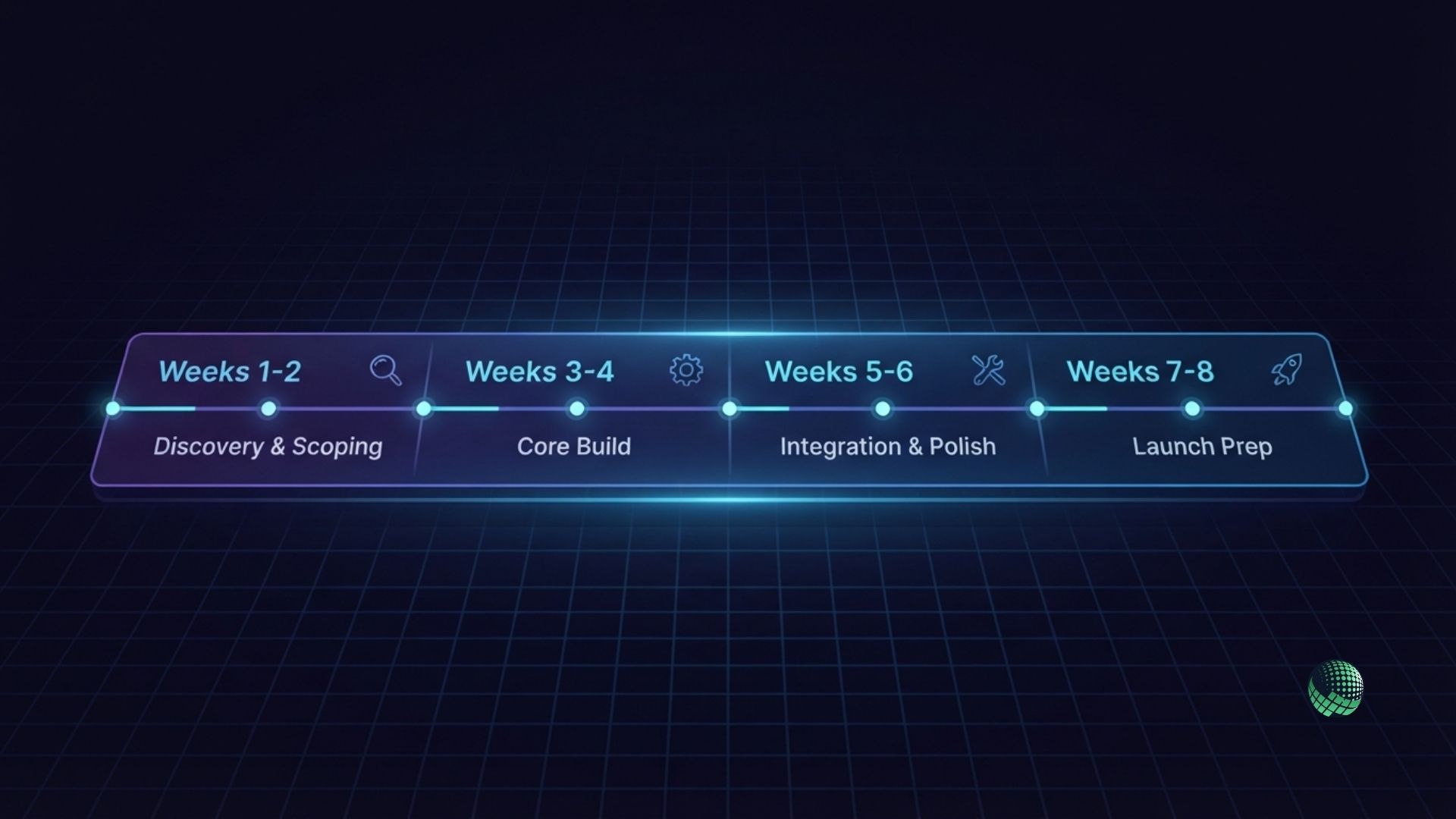
Most startup MVPs — web, mobile, or SaaS — land in the 30–60 day range when scope is disciplined. The platform matters less than founders expect; feature count, backend complexity, and how tightly scope is held after kickoff matter far more.
Curious what your own idea would cost? Try our MVP budget calculator for an instant budget and timeline estimate.
Frequently Asked Questions
How long does it take to build an MVP?+
Most startup MVPs land in the 30–60 day range with the right scope discipline, regardless of platform — a tightly scoped single-feature product can land closer to 30 days, while a multi-feature product with a custom backend typically runs 45–60 days.
Does a web MVP take longer than a mobile MVP?+
Not inherently — the timeline is driven more by feature count and backend complexity than by platform. A simple web MVP and a simple mobile MVP both typically land in the 30–45 day range; the platform itself is a smaller factor than scope.
Why do SaaS MVPs typically take longer than a simple app?+
SaaS products add multi-tenancy, subscription billing, and role-based permissions on top of the core feature set — infrastructure a simple single-user app doesn't need — which is why most SaaS MVPs run 45–60+ days even at a modest feature scope.
What's the fastest realistic timeline for any MVP?+
Around 30 days, and only for a single-feature product built on off-the-shelf infrastructure (Firebase, Supabase) with no complex third-party integrations. Anything promising a fully custom, feature-rich MVP faster than that is usually underscoping the requirements.